


New Jerseyans are used to being ignored, but that does not mean they like it.
The New York Jets play in… New Jersey.
The New York Giants play in… New Jersey.
The New York Red Bulls play in New Jersey, as does the awkwardly named “NJ/NY Gotham FC.” The logo for Gotham FC features the crown of the Statue of Liberty, which itself is located on an island surrounded by New Jersey waters, but which, for reasons likely related to the above-mentioned New York chauvinism, technically belongs to New York.
All of this is a helpful backdrop for another frustration of northern New Jerseyans: WWOR. The station is technically based out of Secaucus, New Jersey, and it is currently branded as “My9 New Jersey.”
However, it has long drawn the ire of politicians in New Jersey because, despite its location, and despite a 1982 law specifically requiring the station to “serve the people of New Jersey” as a condition of its broadcast license renewal, the station largely ignores the Garden State. If you click on the “NJ News” link at the top of the station’s website, you find a grand total of four news stories from all of 2025. Indeed, as recently as 2007, the station branded itself as “My 9 New York.”
Things came to a head in 2013 when the station shuttered its New Jersey local news program in favor of a TMZ-style infotainment program helmed by a comedian and radio talk-show host. Still, the station retained its license, as it does to this day.
‘National’ is not local
I lived in New Jersey when the WWOR controversy was boiling over, and the memory of that time returned to me recently because my current media market is facing a similar situation, albeit without much attention from lawmakers or even the general public.
Three years ago, Sinclair Inc., the third-largest local TV station owner in the United States, dropped local news programming in several markets, including my own market of Sioux City, Iowa. In its place, the company’s Sioux City stations—a CBS affiliate and a Fox affiliate—began airing “The National News Desk,” a national newscast that looks and feels like a small-market local newscast (in some good, but mostly bad, ways).
Big companies rarely just come out and state their reasons for layoffs, and so when Sinclair was asked about the decision back in 2023, they implied that replacing local news with a national newscast was good for local viewers:
“We’re changing the way we produce news in these markets to ensure their long-term success,” the company said, in a statement to a trade publication.
Translation: it’s no longer profitable to produce local news by employing local reporters, and so instead they’re going to… not do that.
Ironically, while “The National News Desk” features local reporting from around the country, that reporting is reliant upon local reporters. Most of the things that happen in a market like Sioux City do not rise to the level of importance that would land them on an out-of-market newscast, and thus the replacement of local news with “The National News Desk” represents an essential deletion of Sioux City news from Sinclair’s broadcasts.
Follow the files
It’s not too hard to see the impact. The Federal Communications Commission (FCC), which grants licenses to local TV and radio stations, requires stations to “air programming that is responsive to the needs and problems of its local community of license.” (Hence all the Garden State frustration with Secaucus-licensed WWOR.)
To demonstrate compliance with that and other requirements, stations are obliged to file quarterly reports offering evidence of how they responded to local issues. Those files must be made available for public inspection. Here’s a portion of the report filed by KMEG—one of Sinclair’s Sioux City stations—in the first quarter of 2022, shortly before Sinclair axed the station’s local news team.
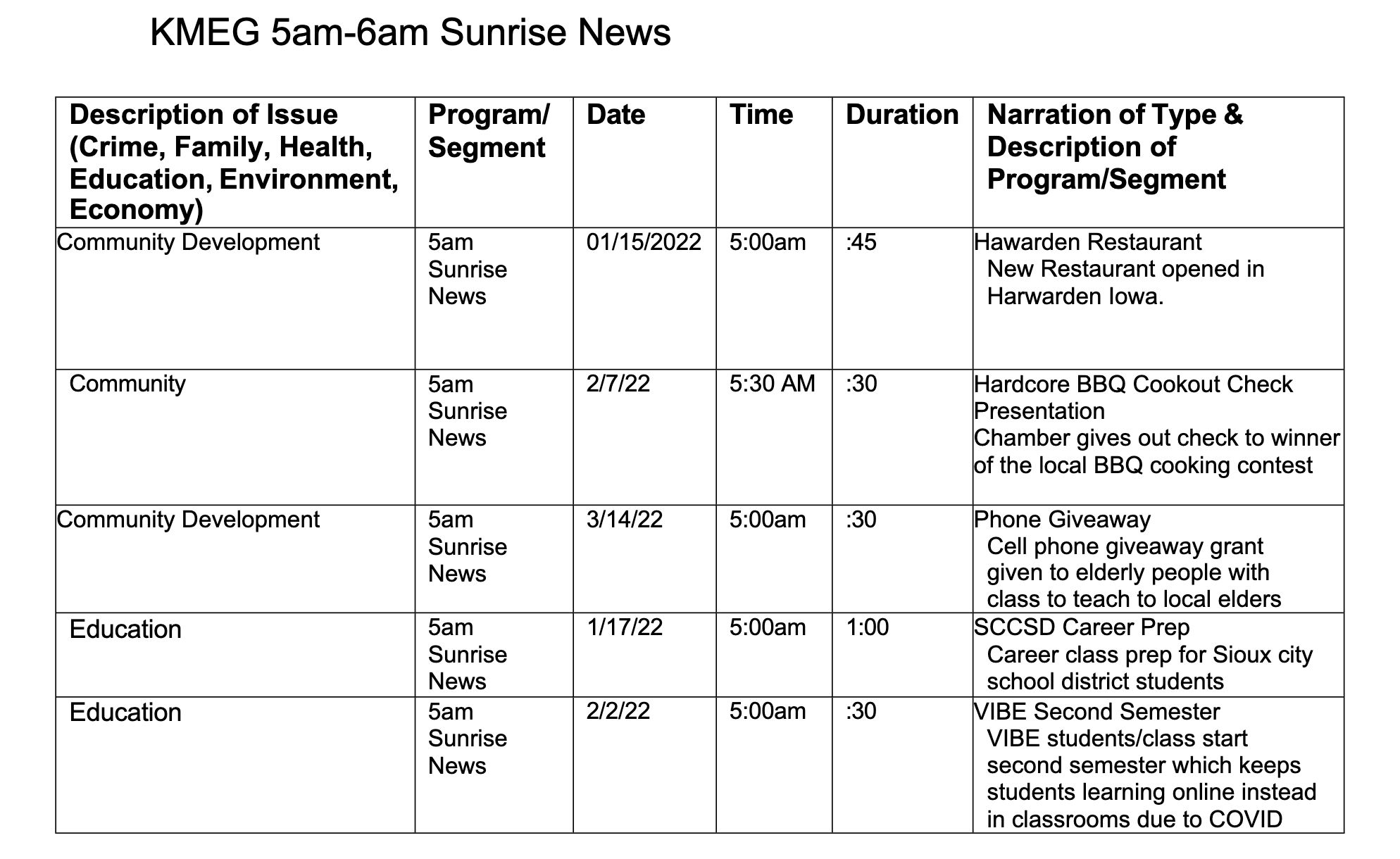
As you can see, the news is hyper-local: a new small-town restaurant, some school news, and a community giveaway.
Now look at the same station’s report from the fourth quarter of last year. The difference is hard to miss:
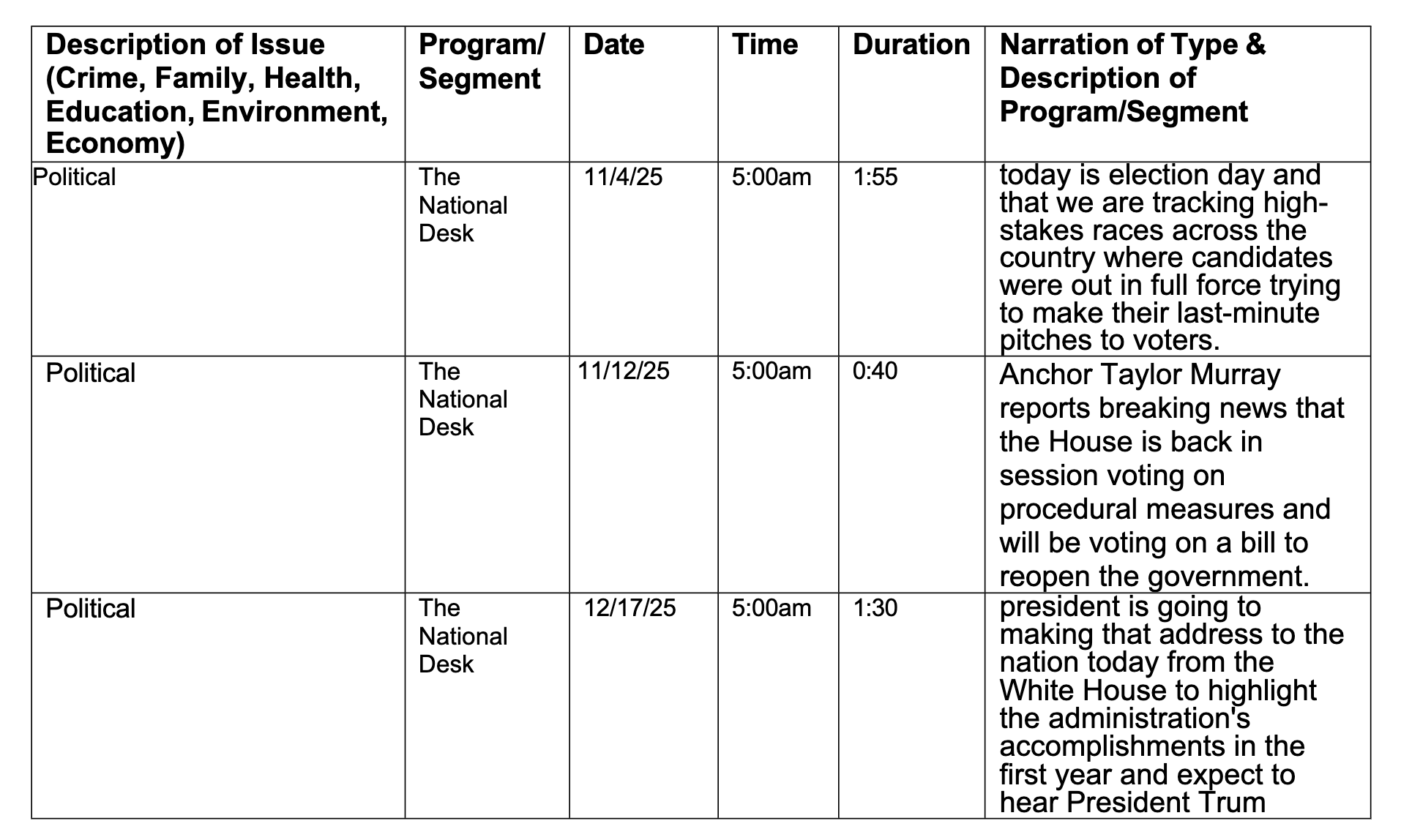
The above is just an excerpt. In total, five segments are listed in the document, all from “The National News Desk.” None of the stories selected as evidence of the station’s responsiveness to local issues mentions Iowa (or neighboring Nebraska and South Dakota, for that matter). In fact, all five segments have to do with national politics or Congress. It’s also worth noting that the person who filed this report did not seem to think it was even necessary to use complete sentences, spell the President’s name correctly, or even get the name of the news program right. (The show debuted as “The National Desk,” but rebranded as “The National News Desk,” in 2024, a full year before this report was filed.)
Who owns these airwaves anyway?
One could certainly argue that the decisions by Sinclair and similar media conglomerates to shut down less-than-profitable local newsrooms is simply a reflection of a deteriorating market for local journalism. Local newspapers have long been in decline, and even some of the core functions of local TV stations—such as urgent weather reporting—have been supplanted by a mix of weather apps and Facebook-based weather streamers.
Yet, it’s worth remembering exactly why local stations have to file quarterly reports on their responsiveness to issues of local concern: it’s a condition of their being given exclusive access to airwaves that fundamentally belong to the public. The internet has made it possible for anyone to become a publisher, or a YouTuber, or a podcaster, or a TikToker. But what the internet has not done—what it cannot do—is turn anyone into a broadcaster.
With a bunch of batteries, an antenna, and a battery-operated TV or radio, I can access broadcast stations, even if the electricity is out or the internet is down. It may not be a lucrative business, but broadcast media remains an important public service.
When companies petition our government seeking the right to control and profit from part of the limited broadcast spectrum, it is only fair for the public to demand that the companies provide something to the public in return. If media companies do not want to be forced to produce programming that benefits the public, they have every right to use other platforms to transmit their programs. However, they should not get the benefit of public broadcast spectrum if they are not providing a public benefit.
Imagine if the FCC actually scrutinized the quarterly reports filed by stations like KMEG. Imagine if they told Sinclair to either provide substantial local news or forfeit the license. There’s a significant chance Sinclair might forfeit the license, and it is not clear whether someone else would step into the gap to take over KMEG’s portion of the spectrum.
I say: So what?
The Sioux City media market is not getting any benefit from its CBS and Fox affiliates, so local residents would not miss much. Arrangements with further afield affiliates could be made to ensure major sporting and cultural events would still be available. The former Sinclair stations’ positions on the broadcast spectrum would once again be available to be used for the public’s benefit should anyone ever decide to provide such a service. Indeed, part of holding the government accountable is demanding that the custodians of public assets steward those assets in a way that aligns with the needs of the public.
People need to know what is going on in their community, regardless of whether providing such information is profitable from a business perspective. The public airwaves provide a unique space to provide such information. We should demand that the airwaves be reserved for entities that are willing to be of service.
Incidentally, anyone can inspect the files of FCC-licensed local broadcasters. Just search for the station here.